Is AI’s Mass Adoption Sustainable? The Environmental Impact and Infrastructure We Need
May 11, 2025
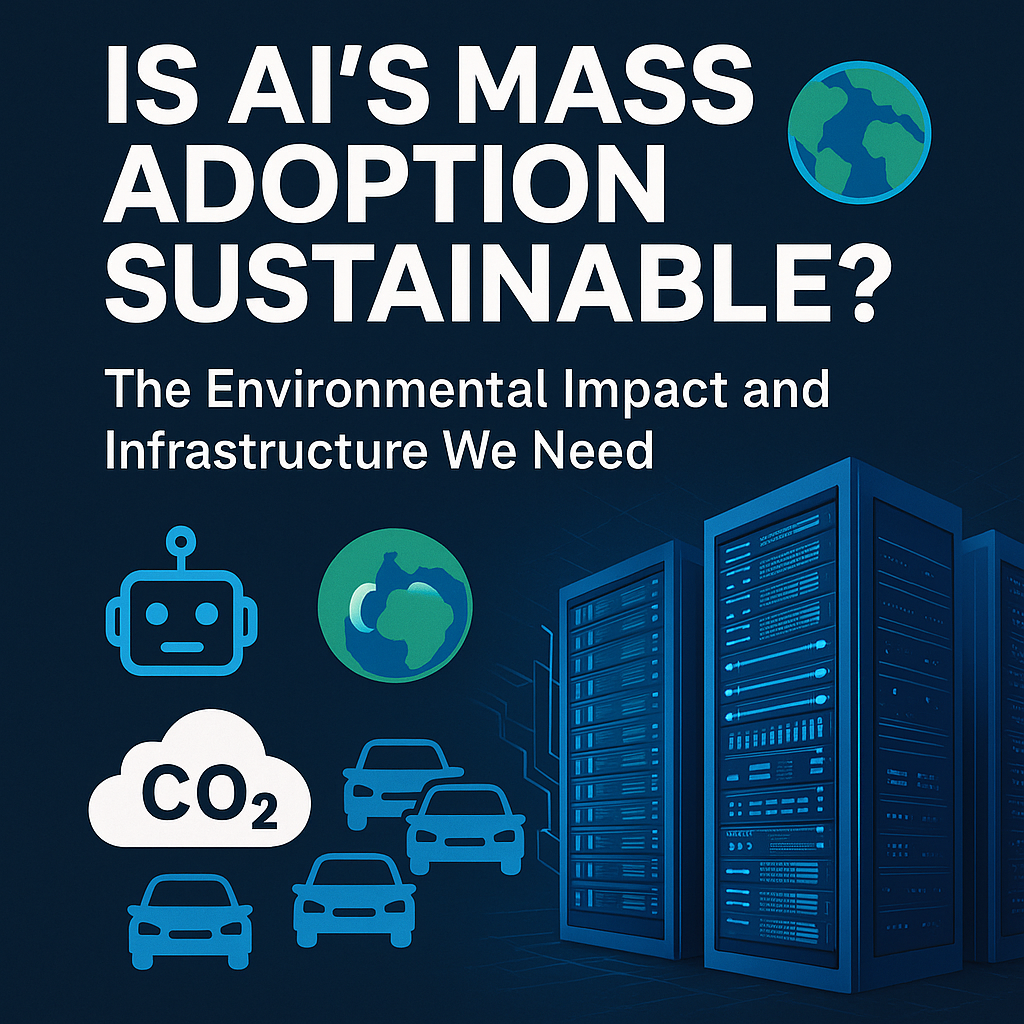
As AI continues its rapid expansion into every industry, we’re entering a new era where large language models and AI tools are becoming as ubiquitous as smartphones and the internet once were.
But this progress comes with a cost and a question worth asking:
Is the infrastructure behind AI sustainable?
The environmental implications of AI are staggering. The energy required to train and operate today’s most powerful AI models is immense. According to a study from the University of Massachusetts Amherst, training a single AI model can emit over 626,000 pounds of CO₂, equivalent to the lifetime emissions of five average American cars.
We now have data centers operating at tens of terawatt-hours annually, and AI workloads are expected to consume up to 3.5% of global electricity by 2030, twice the current power demand of an entire country like France.
And major players are taking note:
- OpenAI is building its own physical infrastructure to improve energy efficiency.
- Microsoft is reportedly scaling back certain data center investments due to infrastructure costs.
This all unfolds at a time when carbon emissions, climate goals, and sustainability are global priorities. The challenge isn’t just about how fast we can build, but how responsibly we do it.
So what kind of infrastructure do we actually need?
- 🌱 Green data centers powered by renewable energy
- ❄️ Cooling innovations to reduce thermal waste
- ⚡ Hardware efficiency and model optimization to reduce compute demands
- 📊 Smarter regulation around AI’s environmental footprint
AI is here to stay, but whether it enhances or strains our planet will depend on the choices we make today.
What do you think? Can AI scale sustainably, or are we underestimating the cost of innovation?
From Sci-Fi to Supply Chains: The AI Revolution and Its Double-Edged Sword
April 24, 2025
What felt like science fiction only a few years ago is now a fast-spreading reality. AI isn’t just transforming tech—it’s reshaping entire industries at breakneck speed. Businesses across the board are racing to adopt AI to stay relevant and competitive.
The benefits are clear and significant:
- Automation & Efficiency: AI reduces manual workloads, streamlining operations with speed and accuracy.
- Smarter Decision Making: With the ability to analyze massive datasets, AI delivers insights and predictions that power data-driven strategies.
- Enhanced Customer Experience: From intelligent chatbots to hyper-personalized recommendations, AI improves customer engagement and satisfaction.
- Cost Reduction: By optimizing workflows and automating tasks, companies can cut costs without sacrificing productivity.
- Innovation Engine: AI opens doors to entirely new products, services, and ways of doing business.
- Competitive Edge: Early adopters can respond faster to market shifts and customer demands.
- Security & Risk Management: AI strengthens fraud detection, risk assessment, and real-time monitoring.
- Scalability: Businesses can scale services and operations more efficiently than ever.
However, as every sci-fi narrative never fails to point out, there are always unintended consequences and potential pitfalls.
Here are the challenges we must confront now:
- Job Displacement: Automation threatens to eliminate roles across industries, especially in customer support, manufacturing, and administrative functions.
- Loss of Human Touch: Over-automation can make support feel cold or frustrating. We've all been stuck in chatbot loops that solve nothing.
- Bias & Ethics: AI systems trained on biased data can perpetuate discrimination in hiring, lending, law enforcement, and other areas.
- Surveillance & Privacy: With AI-driven facial recognition and monitoring on the rise, privacy erosion is becoming a major issue.
- Environmental Concerns: The energy consumption of large AI models is growing rapidly, raising serious sustainability questions.
- Overdependence: Relying too much on AI can reduce human oversight, making organizations vulnerable to errors, outages, or blind spots.
- Weaponization: From deepfakes to AI-powered cyberattacks, the same tech that empowers us can be used against us.
This shift isn’t just technical—it’s transformational. AI is spreading fast, and the businesses that are early adopters will gain a clear competitive edge.
The challenge now isn’t if we adopt AI—it’s how we adopt it responsibly. Striking a balance between innovation and ethics, automation and empathy, will be one of the defining challenges of our generation.
Is Your Business Cloud-Ready or Legacy-Limited?
April 17, 2025
Cloud computing might feel like a modern phenomenon, but the concept actually goes back to the 1960s, when John McCarthy (the same mind who coined the term "artificial intelligence") proposed that computing could one day be delivered as a public utility, much like electricity or water. His foresight laid the conceptual groundwork for what we now recognize as the SaaS (Software as a Service) model and broader cloud services.
Let’s take a quick journey:
- 1990s – Web hosting and remote servers laid the foundation
- 2006 – Amazon launched EC2 & S3, ushering in the age of modern cloud computing
- 2010s – Microsoft Azure, Google Cloud, and others sparked a global transformation
- 2020s – The cloud became essential infrastructure for AI, DevOps, hybrid work, and digital innovation
But here’s the catch…
Many organizations are still running on legacy systems. Why?
- “If it ain’t broke…” – A common mindset, especially in heavily regulated industries like healthcare and finance
- Migration isn’t cheap – It's resource-intensive, time-consuming, and often gets pushed down the priority list
- Embedded Expertise – Long-time staff have deep knowledge of existing systems, making change feel risky
- Performance & Latency Needs – Real-time processing or specialized hardware may perform better on-premises
- Complex Interdependencies – A single change in a legacy system can ripple across critical operations
- Compliance & Data Residency Concerns – High regulatory stakes make businesses extra cautious
- Organizational Inertia – It's not just about tech; change also requires aligned leadership and a cultural shift
But here's the real challenge:
Legacy systems aren't built for the world we now live in.
They’re slowing down innovation. They don’t scale for modern workloads. And increasingly, they can’t support AI or evolving security demands.
The cloud may have taken off in 2006, but in 2025, embracing it fully is no longer optional for most. It’s the launchpad for what’s next.
That said, not every business can, or should, migrate everything to the cloud. For some, regulatory constraints, performance needs, or legacy dependencies make full migration impractical. And that’s okay.
The key is to make an informed decision, not a default one.
Are you building the future, or being held back by the past?